

Introduction — accessibility is the key to true mastery in piano playing
For many, playing piano is much more than a hobby; it is self-expression and the development of one’s creative potential. However, even while there is a real desire to learn, the two most common obstacles are the cost and the time investment required for traditional music education.
It’s worth understanding that accessibility of education is not only a matter of funds; it’s also an organizational component where there’s an opportunity to acquire skills according to a comfortable pace and format. When the process becomes flexible and in tune with the personal schedule, motivation grows, and results do not keep one waiting.
In this respect, modern tools bridge the divide between talent and opportunity, making the piano school virtual and affordable. This frames affordable learning, subscription value, lesson comparison, cost-effective, and Talented budget as practical levers for value for money and lesson savings.
With flexible options and freemium models, a learner can choose the best piano training app for economical practice and ROI on music.
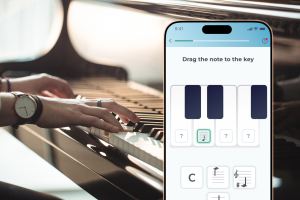
Overview of Application for Effective and Economical Learning of Piano
Our idea is that quality education does not have to be burdened with bulky financial and time-consuming barriers. We will highlight some of the main features of this new tool for learning music.
- Accessible from any place in the world: study pieces, techniques, and theory at your own pace without being bound by lessons at a specific time and place.
- All in one: video lessons, interactive tasks, scores, and theoretical guides right inside the app.
- Personalized learning plans: Your level and goals are gauged to help you progress as much as possible.
- Low cost: The subscriptions or one-time purchases are considerably cheaper compared to lessons with a teacher.
- Community and support: exchange of experience with other learners, online consultations, motivational events.

Cost Comparison Table
| Parameter | Online Application | Traditional Lessons |
| Flexibility | High — learning anytime | Depends on schedule |
| Cost | Below average market price | From average to high |
| Format | Video lessons, interactive | Direct communication |
| Personalization | Automated recommendations | Teacher’s selection |
| Accessibility | Instant start anywhere | Physical presence required |
Such an approach allows one to receive basic skills and discover their talent without any great cost and loss of time. This format is just what people who want to play the piano but aren’t ready to invest large sums or change the usual rhythm of life need. For cost-effective learning, this supports subscription analysis and price breakdown choices aligned with Talented budget.
Benefits of self-directed learning and flexibility in choice of materials
More than just saving money, self-learning of piano playing is the opportunity to become the master of one’s own educational process, to build up the rhythm of lessons, and to select exactly those materials which will correspond to personal interests and skill level. Let’s consider the key benefits of this approach:
- Freedom of choice. You are not bound by fixed programs or schedules. You can personally select lessons, videos, and exercises that suit you, be it classical music, jazz, or modern pop.
- Individual learning pace. The path each one travels at one’s own pace: for some, it means learning simple chords within several days, whereas others spend months studying more complex combinations. Without pressures, one learns at one’s pace.
- Resource availability: the internet is full of free and cheap courses, apps, and books. You can combine different formats: video lessons, audio tracks, scores. It will help to diversify learning and absorb material better.
- Development of independence and discipline: without the external control, it is necessary to develop the habit of regular practice, which will finally turn into one of the main skills for any musician.
However, this high level of motivation and self-discipline is demanded by self-directed learning despite considerable flexibility. Nobody here will urge or correct mistakes if you are not ready to take responsibility for your results.
Savings tips and lesson alternatives can enhance value for money without sacrificing progress.
Costly Lessons — when investments justify themselves on the road to professionalism
Sometimes considered as unjustified expenses, investments in such expensive piano lessons can turn out to be important steps toward professional development. Under what circumstances is such an investment really meaningful?
- Individual approach of the teacher: An experienced teacher can pick out weak points, faulty habits, and help correct them early on.
- Professional technique correction: Only live interaction can provide fine-tuning of posture, hand positioning, and finger movement so important for long-term health and skill development.
- Motivation and regularity of lessons: Compulsory scheduled lessons create discipline, while feedback fuels interest for constant progress.
- Access to exclusive materials and performances: With expensive courses, often come master classes, studio recordings, and performance options at concerts that are simply not possible in self-study.
- Support in preparation for exams and competitions: An experienced teacher will help not only in technical preparation but also in psychological tuning for performances.
Such lessons require considerable financial and time costs. Results heavily depend on the student’s personal involvement. However, in those places where self-learning cannot give enough impetus, paid lessons are able to raise the level of skills more quickly and with higher quality. Financial planning helps weigh lesson investment against expected ROI on music.
Comparing Results — real success stories with budget and premium piano learning
If speaking about achievements in piano playing, it is always interesting to look at concrete examples of how and up to what heights people overcome difficulties, choosing either budget courses or lessons with professionals. Below, a collection of real stories is presented that permits establishing what can be gained in each option.
Success Stories using Budget Learning (e.g., via Talented, among other online venues)
- Anna, 28 years old. Without any help from anyone, she started practising piano, using materials and courses available on Talented. She played simple melodies at first, but in half a year already, she could learn complicated pieces with titles based on classics and pop music. Nowadays, Anna regularly performs at local concerts and runs her blog, where she shares her recommendations for other beginners.
- Maxim, a student. Seriously was not planned to be engaged at first, but thanks to flexibility and accessibility of instructional videos basic techniques were mastered and musical ear developed by him. His main victory — participation in a student contest with a composition of his own which won first place.
Success Stories with Expensive Lesson Payments
Elena is a professional teacher and concert pianist. She studied, attended master classes, and took part in international competitions throughout her childhood under the guidance of renowned instructors. The masterly classes and constant feedback raised her technique and the level of expressiveness of her playing high, so she was invited to perform with orchestras and record albums.
Igor is an IT specialist, amateur musician. He invested in individual lessons recognized by masters, which allowed him to quickly eliminate mistakes and learn the subtleties of interpretation, save time in independent searches for information. The result is participation in prestigious festivals and growth of musical career in free time from work.
Key differences in results
- Progress time
It requires more independence and patience, but in a budget option, it allows moving at one’s own pace. Premium learning speeds up the process due to an individual approach. - Depth of knowledge and technique
The topics covered online range from basic to intermediate, but live interaction with a teacher is irreplaceable. Individual lessons will help to hone the details and prepare professionally for performances. - Cost and motivation
The freedom of choice and low investments can create persistence and allow creative exploration. More expensive lessons create a sense of responsibility and discipline, thanks to structure and regular control.
It can thus be concluded that an independent and inexpensive learning method is an excellent way for those who start or want to play for fun. For those who aim at the professional level and performances, an investment in paid lessons is often justified and efficient. Yet, success stories prove that the main thing is not the price of education but consistency, love for music, and the ability to use available resources with maximum dedication. This is where lesson comparison informs budget lessons versus premium, clarifying subscription value and cost-effective routes.
The balance of motivation, money, and time — how to choose an appropriate learning method
Far from trivial is the task of choosing an effective path in learning to play piano. Students and their parents are in the grasp of this dilemma — whether to invest considerable sums into premium lessons or opt for cheaper online resources offering a wide array of materials and flexibility in one’s schedule. The real problems to be considered involve matching one’s financial capabilities with three key success factors, namely motivation, money, and time.
First, time allocation: the regularity and consistency of playing piano require. The very lack of free time is a main barrier on the road to mastery for many beginners. When it is convenient, online platforms give one an opportunity to practice without being attached to a teacher’s schedule. However, lessons with a personal tutor usually demand strict adherence to a timetable, which suits not everyone.
Second, these are financial investments. That expensive sessions, though often offering an individual approach and deeper immersion, do not always guarantee better results if motivation and diligence are lacking in the student, is the point. While in more budget-friendly solutions, one is allowed to try different methods and choose the most comfortable learning style without significant expenses at all.
Thirdly, and perhaps most importantly — motivation and discipline: even the most expensive mentor will not be able to secure continuous progress if there is no internal interest in improving. On the other hand, easy access and the opportunity to learn at a comfortable pace can stimulate a student to continue with practice.
Practical recommendations
- Look at your schedule and determine how much time you can reasonably devote to lessons per week.
- Look at the financial possibilities and consider how justified investments in expensive lessons are, given your level of motivation and goals.
- Personal preferences: Which one is closer to yourself: a structured teacher or independent self-study?
- Do not be afraid to mix and match methods: sometimes an intelligent combination of online resources with occasional professional consultations produces great results.
In other words, the balance of motivation, money, and time is not a formula for choice; it’s a process that is dynamic and needs to be self-observed, with adjustments. We strongly believe as developers that with modern tools, piano learning can be made as comfortable and accessible as possible without minimizing the role of diligence and personal involvement. Leaning on Talented budget options can keep value for money high while exploring lesson alternatives that are cost-effective.

Conclusion — a reasoned approach to mastery combining talent, resources, and consistency
In learning to play the piano, like in any other art, there is no formula whereby success can be assured.
However, summarizing the investigated methods of teaching, a number of general principles can be outlined that will help to create the best path to mastery.
- Talent — not the only factor, but an important start
Undoubtedly, natural musical hearing and a sense of rhythm form a reliable basis for studying the instrument. But even inborn talent does not unfold without guidance and regular practice. - Resources — maximally adapted to your possibilities
Budget-friendly online platforms, such as Talented, provide wide opportunities to begin and then regularly practice without major financial expenditures. While paid individual lessons can go in-depth, provide feedback, and early mistake correction, they demand a far greater investment. - Consistency — the key for development and stable progress
What is more important is not the rare but extended sessions, but regular practice and systematic mastering of new techniques and exercises. Self-discipline and systematization often outmatch spontaneous enthusiasm.
Before proceeding further, let me sum up: such a learning algorithm for selection can be designed.
Thus, piano mastery can be achieved by harmoniously combining three important components: talent, effective resources, and systematic practice. Establish realistic goals, make use of what you have, and don’t be afraid to try different learning styles. Only such a reasoned and individual approach will enable not only saving money but also achieve real results. This ties together affordable learning, subscription value, and cost-effective choices for sustained value for money under a thoughtful subscription analysis.